Assisted Stretching & Mobility
Assisted Stretching Therapy
You know the tightness that never quite goes away on its own — the hips that feel locked, the shoulders that won't fully open. Flex & Flow works with your body's natural mechanics to restore the range of motion you've lost, ease the tension you've been carrying, and leave you feeling longer, looser, and genuinely lighter. No oil, no table, just you — fully clothed — moving the way you were meant to.
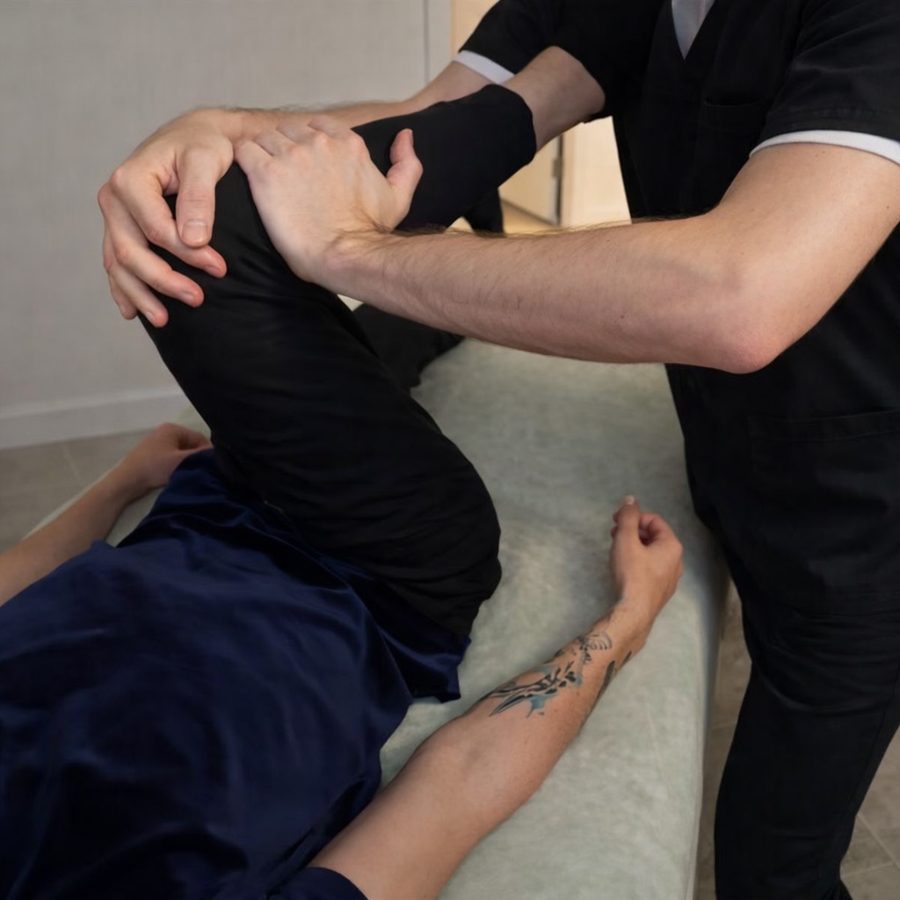
Every body is different — where you hold tension, how much mobility work you've done, what you're hoping to get back. Flex & Flow offers three session formats to meet you where you are. All sessions are performed fully clothed; wear comfortable, free-moving clothing.
Assisted stretching is a collaboration. Unlike a massage where you simply receive, Flex & Flow asks you to engage. That active participation is exactly what makes it so effective.
Forcing a muscle to stretch triggers a protective reflex that fights the stretch. We use techniques like PNF — where you briefly contract the muscle before releasing — to bypass that reflex entirely. The result is a deeper, more lasting release than passive stretching alone can achieve.
You'll be cued to gently push against resistance, hold briefly, then let go. This engage-and-release cycle activates the target muscle, then coaxes it into a longer resting length. It may feel unfamiliar at first — but within a few cycles, the body learns to let go in ways it hadn't before.
Exhaling drops the nervous system's guard. Every stretch is timed with your breath — we move deeper on the exhale, hold at the edge, and reset on the inhale. Over the course of a session, this rhythm becomes almost meditative, and the body's willingness to open compounds steadily throughout.
No two bodies move the same way. Before we begin, we assess where you hold restriction and what your goals are — so every stretch, hold, and transition is specific to what your body actually needs, not a generic sequence.
The brief moments of muscle activation during PNF stretching are what set this work apart. By contracting before releasing, the nervous system stops protecting and starts allowing — leading to gains in range of motion that purely passive stretching can't match.
We work specific muscles — the ones contributing to your particular pattern of tightness — rather than general regions. Specificity is what makes the work feel precise, intentional, and genuinely therapeutic rather than routine.
Breath isn't background here — it's technique. Every stretch is coordinated with your exhale to maximize softening of the tissue and reduce discomfort. The rhythm of breath and movement is one of the most effective tools we have.
Abrupt movement triggers bracing. We move through each stretch with control and continuity so the body stays relaxed and receptive throughout. The session has a flow to it — not a series of discrete positions, but one integrated movement experience.
We never push into pain. Range of motion improves by working consistently at the appropriate edge — not by forcing it. Each session builds on the last, and sustainable progress is always the goal over quick but short-lived gains.
Greater range of motion without adequate stability is just instability. We integrate activating and lengthening work so your new mobility is functional, controlled, and something your body can actually use — in the gym, at work, or in daily life.
We close every session with a brief integration — slowing the pace, bringing awareness to the body as a whole, and letting the nervous system settle into its new baseline. You leave feeling open, but also centered and grounded.
"Flexibility isn't just about being able to touch your toes. It's about having a body that moves freely through everything your life asks of it."— The Flex & Flow Philosophy
A Flex & Flow session has a clear rhythm. Here's how a standard 60-minute session unfolds — though every session is adapted to your needs in the moment.
Flex & Flow draws from a range of evidence-based stretching and movement modalities. These aren't applied randomly — each technique is chosen for a specific purpose within the session.
Proprioceptive Neuromuscular Facilitation — the gold standard of assisted stretching. By contracting a muscle against resistance before releasing into the stretch, the nervous system allows greater depth and lasting change in muscle length. Highly effective for both flexibility and neuromuscular re-education.
Controlled, flowing movements that take joints through their full range in a rhythmic pattern. Dynamic work warms the tissue, activates supporting musculature, and prepares the body for deeper, more targeted work later in the session. It also improves proprioception and movement quality.
A technique that combines lengthening a muscle with deliberate activation of its opposing group. When one side contracts, the other is neurologically cued to release — a mechanism called reciprocal inhibition that produces deeper, more effortless relaxation of the target tissue.
You relax completely; we do the work. Passive holds are used strategically — after active techniques have already primed the nervous system — to let tissue settle into its new length. Held long enough to stimulate connective tissue remodeling without triggering a protective reflex.
Drawing from traditional Thai bodywork and yoga-based movement, these assisted postures mobilize the full kinetic chain — spine, hips, shoulders — in ways that table-based stretching alone cannot reach. These stretches address whole-body patterns, not just isolated muscles.
Improved flexibility is the visible outcome. The deeper effects — reduced pain, better sleep, calmer nervous system, more fluid movement — are often what keep people coming back.
Measurable increases in joint range of motion — often felt immediately. PNF techniques consistently outperform static stretching for both short-term gains and longer-term mobility improvements when practiced regularly.
Greater range of motion supported by properly activated stabilizing muscles means your body moves more efficiently and with less compensatory strain. Strength and flexibility working together — not one at the expense of the other.
Chronic tightness is often more neuromuscular than structural — the nervous system has simply learned to keep certain muscles contracted. Flex & Flow interrupts that pattern, giving the body a new baseline to work from.
Stretching increases local blood flow and lymphatic circulation, supporting tissue recovery and reducing residual soreness after physical activity. Athletes and active individuals often notice faster bounce-back between training sessions.
Stiff joints restrict movement and place compensatory load on surrounding tissues. By working through end-range positions with support and control, Flex & Flow gradually restores joint health and reduces the wear patterns associated with restricted movement.
Greater usable range of motion translates directly into better mechanics — in running stride, squat depth, shoulder mobility for swimming or lifting, and everything in between. Many athletes incorporate regular stretch sessions as part of their performance programming.
The combination of rhythmic movement, breath guidance, and hands-on support activates the parasympathetic nervous system — the body's rest-and-repair mode. Many clients describe a deep calm that lingers well beyond the session itself.
Flex & Flow isn't just for athletes or the already-flexible. If you have a body that moves — and one that doesn't always move as freely as it should — this service was designed with you in mind.
The answer depends on where you're starting and what you're working toward. Here's a general framework — we'll give you a personal recommendation at the end of your first session.
If you're dealing with significant limitation — chronic hip tightness, frozen shoulder, post-activity stiffness that impacts daily function — more frequent sessions in the beginning help establish a new neuromuscular baseline. The body learns fastest with consistent input.
Recommended: Weekly sessions for 4–6 weeksYou're seeing improvement, moving better, and holding your gains between sessions. Now the goal shifts from recovery to reinforcement — deepening the work, addressing secondary patterns, and beginning to build the kind of flexibility that becomes your new normal.
Recommended: Biweekly sessions for 6–8 weeksYou've made the gains. Now it's about keeping them — and continuing to build. Regular stretch sessions as part of an ongoing wellness or performance practice. Most clients at this stage describe the work as irreplaceable: a non-negotiable part of how they take care of their body.
Recommended: Monthly or as-neededA calm, private room. Soft light. Comfortable table. Everything about the environment at Awaken Zen Spa is designed to help your body let go before the session even begins.
Real words from people who've been on the table. We'll let them speak.
"Your client quote goes here — ideally something specific about how the session felt, what changed in their body, or what they noticed in the days after."
Paste real client reviews here — Google Reviews, direct quotes, or anything clients have shared with you.
Flex & Flow sessions book quickly — especially evenings and weekends. Reserve your time online, or reach out if you have questions about which session is the right fit for you.