
I become differentiated... I am an individual with my own spine.
I ground myself in my own sphere through yielding and pushing... I reach and pull, giving attention to my outer environment.
I follow my curiosity and my imagination... enjoying my supportive, flexible, playful, sensuous spine.
All things seem possible.
There's a quality that a healthy spine has — a quality that's hard to name but unmistakable once you've felt it. A kind of aliveness. A sense that the whole length of it, from the base of the skull to the tip of the tailbone, is in fluid communication with itself. That when the top moves, the bottom knows. That when the tail initiates something, the head gets the message and responds.
That quality is what movement pioneer Irmgard Bartenieff called head-tail connectivity. And what I want to talk about in this post is what happens when it goes quiet — when parts of the spine lock into fixed relationships, when the conversation between head and tail becomes stilted or stops altogether, and the body compensates by twisting around the disconnection.
Because that's what rotational compression actually is, at its deepest level. It isn't just a mechanical problem — a tight muscle here, a stiff joint there. It's a spiral pattern that builds when the spine stops moving as a unified, responsive whole and instead develops fixed zones that hold while the mobile zones overwork to compensate. Over months and years, that pattern winds itself into the fascial system, the muscle firing sequences, the way you walk, the way you breathe, the way you turn to look over one shoulder but not the other.
And by the time it shows up as pain — usually somewhere that seems unrelated to the original pattern — the spiral has been building for a long time.
What Rotational Compression Actually Is
Think about a simple everyday action: always turning your head left while working at a screen positioned off-center. Always reaching across your body to the right to answer the phone. Driving long distances with your right arm resting on the door and your torso slightly rotated toward it. Playing a sport that requires the same rotational movement repeatedly on the same side. Working a job that consistently demands more from one arm than the other.
None of these things are harmful in isolation. But the body is a pattern-forming system. Repeat the same rotational load enough times and the fascial system — that continuous three-dimensional web we talked about in Post 1 — begins to adapt. It thickens and shortens along the lines of repeated stress. It loses glide in the directions that aren't being used. And very gradually, what was a movement pattern becomes a structural one.
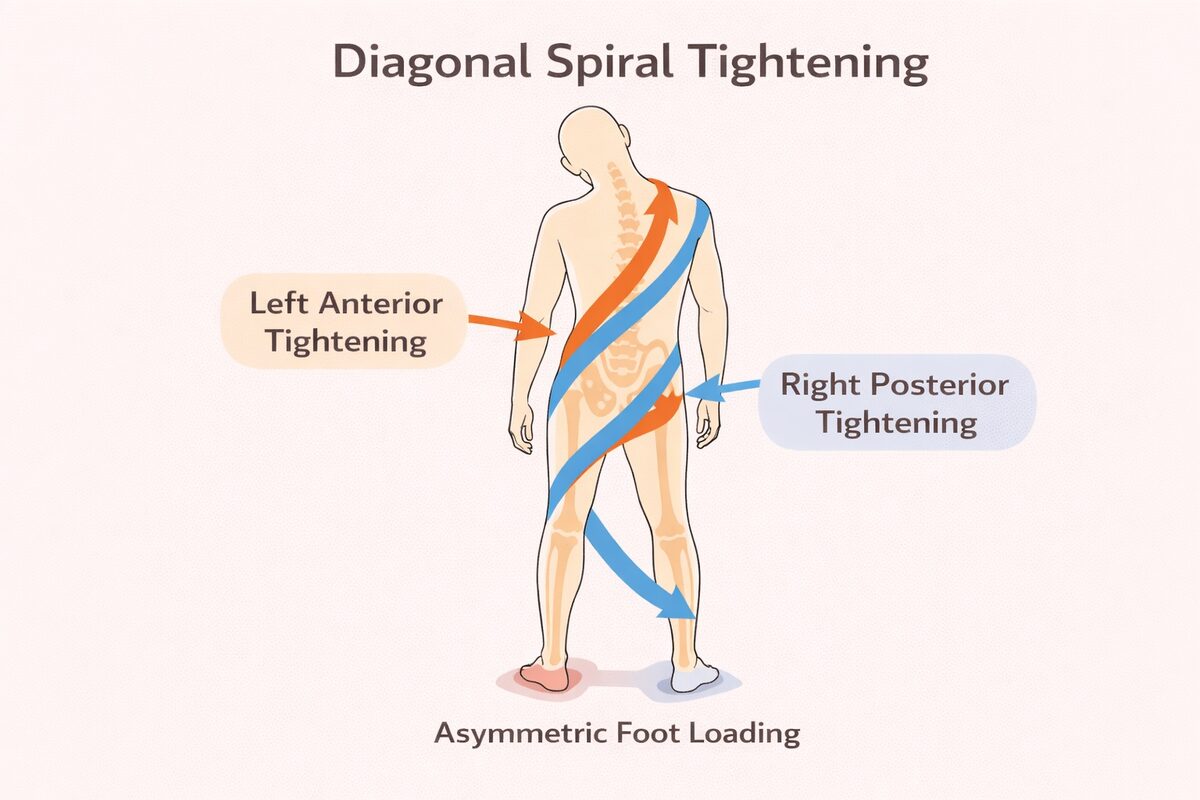
The result is a helical torque — a twist that winds through the entire body along the spiral fascial lines. The left anterior body tightens: pec major, SCM, anterior scalenes, obliques all pulling forward and across. The right posterior body tightens in response: levator scapulae, paraspinals, quadratus lumborum all bracing on the back. And the body organizes itself around this diagonal tension line, pulling in opposite directions at the top and bottom of the spiral.
Rotational compression isn't just a tight muscle. It's the whole body organized around a diagonal — one side reaching forward while the other braces back — and the spine caught in the middle of a conversation it can no longer resolve.
Who Develops This Pattern
Rotational compression is one of the most universal patterns I see — because almost every human activity has a preferred direction. Here are the people who show it most consistently:
The Downstream Effects: What a Helical Torque Does to the Whole Body
Like every compression pattern we've explored in this series, the rotational spiral doesn't stay in one place. Because the fascial system is continuous, the torque travels — and it creates a set of downstream consequences that are remarkably consistent across different bodies and different occupations.
The Deeper Story: When Head and Tail Stop Talking
I want to step back from the anatomy for a moment, because there's a way of understanding rotational compression that I find much more illuminating than any muscle list — and it comes from the movement tradition of Irmgard Bartenieff, whose work in somatics and movement fundamentals remains some of the most insightful body education I've encountered.
Bartenieff described a principle she called head-tail connectivity — the idea that a healthy, alive spine has a continuous fluid relationship between its two ends. The head and the tail are always in conversation. When one moves, the other knows. When the tail initiates, the head gets the message and follows. When the head leads, the tail responds and supports.
This isn't metaphor. It's neurological reality. The spine is the central conduit of the nervous system. Movement information travels up and down it constantly. The subtle undulating motion of the spine during walking, breathing, and reaching is the physical expression of that ongoing dialogue — the head and tail finding each other through every action.
What she observed — and what I see confirmed constantly in bodywork — is that most people are not using this connectivity. Instead, they've developed fixed relationships in specific zones of the spine. The lower back holds rigid. The chest is set forward and up. The neck maintains a locked position relative to the head. And where fixity enters, the fluid conversation between head and tail is interrupted.
Every pattern of holding reduces the fluid nature of movement — and therefore the possibilities available at any moment. A small change in availability of any part of the spine creates a large change in possibilities at the distal end of the limbs.
In other words: free up a fixed thoracic segment, and the reach of the arm changes. Release a held lower back, and the ease of the leg swing changes. The spine is not a supporting rod. It is a transmitter. When it goes quiet in sections, everything downstream operates with less information, less grace, and more compensatory effort.
Rotational compression is what the body looks like when the head and tail have developed a fixed, asymmetric relationship — when one end is perpetually reaching or turning in one direction and the other end has stopped responding fluidly. The spiral builds in the gap between them. The fascial system hardens around the pattern. And the movement possibilities that Bartenieff described — the playful, sensuous, curious spine that makes all things seem possible — slowly narrow.
The Reach That Left the Ground
There's another concept from Bartenieff's work that I think is essential to understanding how rotational patterns develop in the first place — and it has as much to do with how we live as how we move.
She described two fundamental movement phrases: yield and push, and reach and pull. These aren't just physical descriptions. They're the basic grammar of how a body engages with the world.
Bartenieff identified a frequent and telling problem: people reaching far beyond themselves and disconnecting their movement from themselves, because they are not sequencing from a yield and push to support the reach. They skip the ground. They go straight to the extension without the preparation that makes extension stable.
Sound familiar? It's the body of urgency. The body of constant doing, constant reaching, never quite returning to ground. And in a physical sense, it's the setup for rotational compression — because a reach that isn't supported by a grounded yield has to recruit stability somewhere else. The spine twists to find it. The fascia tightens along the spiral to create the stability that the ground didn't provide. And the pattern becomes structural.
The Archetype: "The Fixer"
The Fixer
"Always Leaning Forward Into Life"
Whole body leaning forward, head leading, arms slightly out — already reaching for the next thing before this one is finished. The structural signature is a shortened anterior line: the front of the body is always moving toward, while the back is trying to keep up. The pelvis tends to rotate forward. The thorax twists slightly toward the dominant side. The back muscles on the opposite side brace to hold the forward momentum from continuing unchecked.
The emotional signature of this archetype is urgency, caretaking, and a subtle but pervasive guilt about not doing enough. The body is perpetually on its way somewhere — and the spiral that builds in the fascia reflects the same pattern: always extending into what's next, rarely fully returning to ground.
What this archetype needs — both physically and in a broader sense — is not more reach. It's more yield. The ground that makes reaching sustainable. The pause before the push. The deep exhale that precedes the next inhale. Without the yield, the reach keeps pulling the spiral tighter.
The Position of Comfort That Tells the Story
There's a characteristic comfort position for people in rotational compression patterns that I see constantly — and once you know what you're looking at, it's unmistakable. It's the person who habitually sits with their torso slightly rotated toward one side, one leg crossed over the other in the direction of the rotation, one arm extended across their body. They look relaxed. What they're actually doing is unloading the compressed side of the spiral by giving it what it wants: more of the same rotation, but passive instead of effortful.
The crossed-leg habit is particularly diagnostic. Which leg always goes on top? Almost always the leg on the side toward which the pelvis has rotated — the body seeking to close the compressed SI joint further rather than fight the pattern. It's not a bad habit. It's the body managing its own load as efficiently as it can with the resources available. But like all postural comfort strategies, it reinforces the very pattern it's temporarily relieving.
Is rotational compression part of your pattern?
- Can you turn your head equally far in both directions, or does rotation to one side feel noticeably more restricted?
- When you cross your legs, do you always cross the same one on top?
- Is there one side of your low back, hip, or rib cage that's consistently tighter than the other — and seems to return regardless of how much you stretch or treat it?
- Does your habitual work posture or activity consistently require more rotation or reach to one side?
- When you look at a photo of yourself from behind, does one shoulder blade sit differently from the other, or does one hip seem rotated forward?
- Do you notice that one foot tends to turn out more than the other when you walk or stand?
- Does one side of your jaw feel tighter, or does your bite feel subtly uneven?
- When you think about activities you do most — driving, working, sleeping — do you consistently favor one direction of rotation?
Unwinding the Spiral — What Actually Helps
Rotational compression responds particularly well to bodywork that works with the spiral lines rather than against them. Techniques like Lomi Lomi — the long, flowing, bilateral strokes of traditional Hawaiian massage — are so effective for these patterns precisely because they address the full length of the spiral fascial chains in a single movement. The therapist's hands travel from one diagonal end of the pattern to the other, encouraging the tissue to remember the fluid through-connection it's lost. The work doesn't isolate the tight spot. It follows the line.
Similarly, bamboo massage — with its rolling pressure and long longitudinal strokes — can reach the deeper layers of the spiral fascial web in ways that hands alone sometimes can't. The bamboo follows the grain of the tissue, releasing along the lines of compression rather than across them.
But beyond specific techniques, what rotational patterns most need is the restoration of head-tail connectivity — the return of that fluid conversation along the length of the spine. Sometimes this comes through manual therapy. Sometimes it comes through movement — the slow, exploratory spinal undulation that Bartenieff described, where the wave of movement is allowed to travel from tail to head and back again, finding the stuck segments and gradually inviting them back into the conversation.
And sometimes — honestly — it comes through learning to yield before you reach. To feel the ground before you extend into the next thing. To let the exhale complete before the next inhale begins. The body knows this rhythm. It was built for it. Rotational compression is often, at its root, a pattern of forgetting it.
In Post 5, we go deeper into something that shapes every compression pattern we've covered so far — and explains why so many of them return after treatment. The reason massage doesn't always last isn't that the massage was wrong. It's something more fundamental about inhibition, collapse, and the correct sequence for changing a pattern rather than just temporarily relieving it.